

Brazilian Exotic Granite does not publish a color sales ranking, so start with palette families. At our San Diego yard in Miramar and our San Marcos yard, homeowners often ask about whites and creams, blacks, golds and browns, and blues. To get started, check out one slab from each family, for example White Splendor, Black Agata, Giallo Ornamental and Blue Pearl.
Below, each family is broken down slab by slab, in the words of each product page. National research appears only to explain a color direction, labeled as a national look at kitchens overall, not granite sales or San Diego. The goal: three or four slabs worth seeing in person.
Here is the quick reference.
| Granite color | Family | Background or base | Veining and movement |
|---|---|---|---|
| White Splendor | Whites and creams | Creamy white | Chocolate brown minerals and black veins |
| Alaska White | Whites and creams | Tonal whites and creams | Darker brown or gray highlights; medium variation |
| Salinas White | Whites and creams | Snowy white | Dense clusters of onyx speckles |
| River White | Whites and creams | White with cream, blue and gray tones | Linear veins, blue/gray to burgundy |
| White Ornamental | Whites and creams | Lighter whites and creams | Dark charcoal and black veins |
| Black Agata | Blacks | Dark black | Light gray and white wavy veins |
| Black Cosmic | Blacks | Mostly black | Swirls and veins of creams and gold |
| Stormy Night | Blacks | Black | Dramatic snowy white veins; tonal veins |
| Titanium | Blacks | Deep black | Swirling white and gold veins |
| Giallo Ornamental | Golds and browns | Tan | Dark gray and brown veins; polished finish |
| Brazilian Wood | Golds and browns | Variation of creams, yellows, golds and browns | Not described on the product page |
| Golden Crystal | Golds and browns | Soft gold, beige and light gray | Deep brown and amber mineral deposits; flowing patterns |
| Toffee | Golds and browns | Shades of gold and browns | Rich and warm |
| Juparana Persa | Golds and browns | Gold tones and creams | Deep charcoal veins; high variation |
| Blue Pearl | Blues | Blue, dark blue or gray-blue | Silver or blue iridescent mineral flecks |
| Opala | Blues | Hues of blues | Highlighted with white and gray |
In short: pick one of four families (whites and creams, blacks, golds and browns, or blues), then compare slabs inside it.
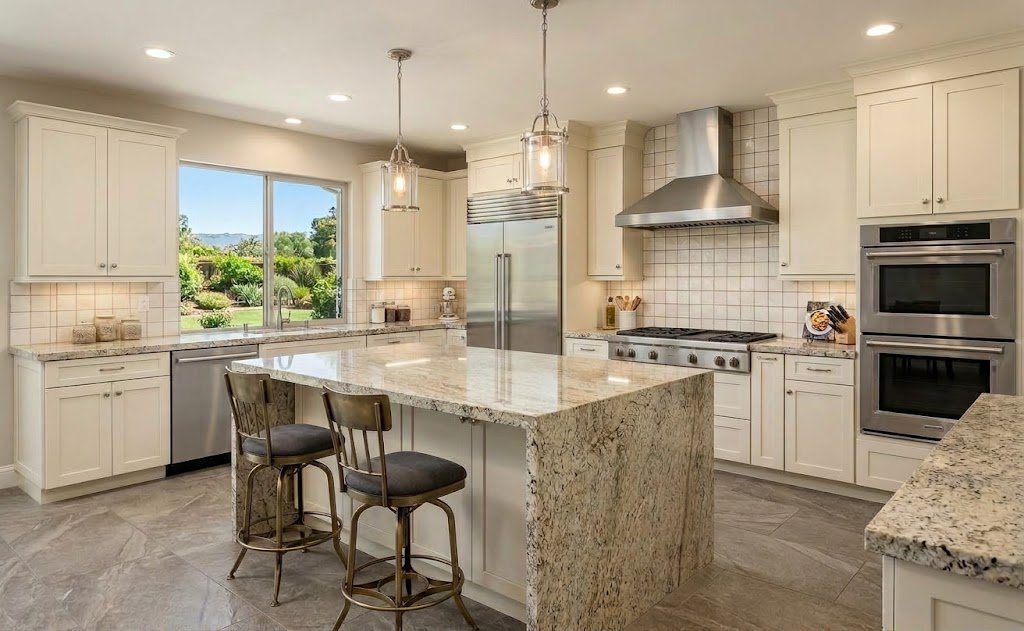
How Do You Pick a Granite Color for a San Diego Kitchen?
Choose the color family first, then the exact slab. Four things shape that decision: the light in your space, your cabinets, the setting of your home and how natural stone varies from one piece to the next. For more background, see our granite countertops and slabs page and our countertop guide.
How Does the Light in Your Kitchen Change a Granite Color?
Light changes how granite reads. A pale slab brightens a room, while a dark one absorbs light and appears deeper. The same stone can look warm in afternoon sun and cooler under overhead fixtures, because what you see is always reflected light. Finish matters too, since a polished surface reflects more than a honed or leathered one. Judge each option by daylight, not on a phone screen; at our San Marcos yard you browse full slabs in natural light.
How Do You Match Granite Countertop Colors to Your Cabinets?
Start with the cabinets, since they cover more of the room than the countertops do. Nationally, the NKBA 2026 Kitchen Trends Report, a survey of kitchen trade professionals about kitchens overall (not granite and not San Diego), found wood grain cabinets growing (59%) and white oak the most popular wood (51%). Houzz’s 2026 surfaces trends from KBIS, a national report on kitchen surfaces overall, note that warm neutrals pair well with natural wood tones. Brown, taupe or gold veining shares warm undertones with wood, so the two come across as one palette. That is a guideline, not a rule, and painted or dark cabinets can work with almost any family if you like contrast. Bring a cabinet door and a floor or tile sample to hold up against the full slab.
Should Coastal and Inland San Diego Homes Choose Different Colors?
No rule says a coastal kitchen needs white or an inland one needs gold. In general design terms, airy, light palettes suit bright rooms open to the outdoors, while warmer earth tones feel grounded and cozy. Either way, light and surroundings shape how a shade reads. So choose for your own light, cabinets and floors rather than your zip code. Then confirm the choice against the full slab.
Why Pick the Color Family First, Then the Slab?
Narrowing to one family makes a large inventory manageable, because you only compare a handful of options that already suit your kitchen. Natural stone varies in color, veining and pattern, and no two slabs are alike. Veining, the lines or streaks of other minerals running through the stone, is exactly what a small sample or photo shows worst. Narrow it down to three or four candidates in one family, walk them at the yard and tag your favorite. Once you tag it, we hold it for your project.
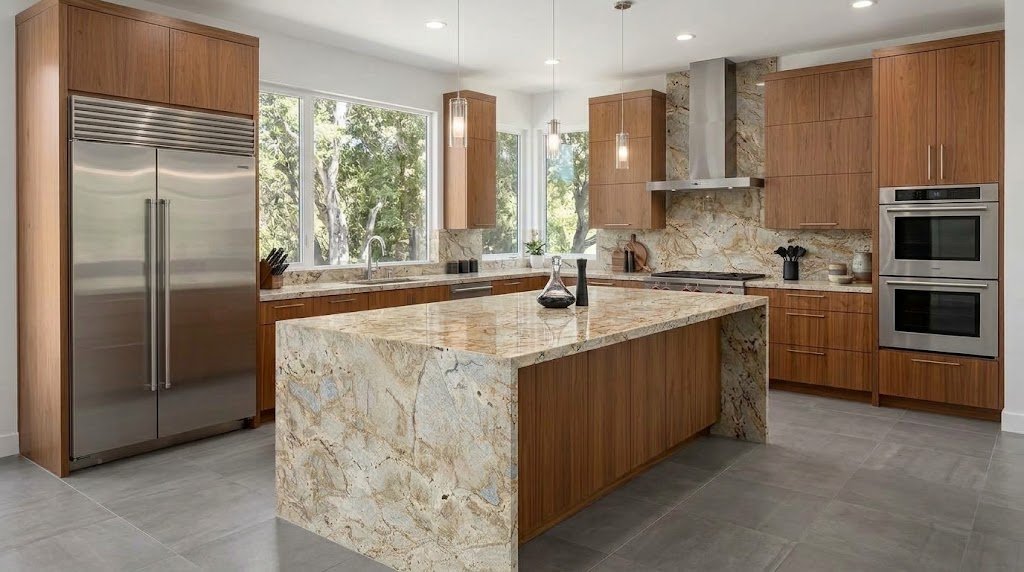
Which White and Cream Granite Colors Should You Shortlist?
This family runs from soft, tonal creams to bright whites with crisp speckles.
What Does White Splendor Granite Look Like?
White Splendor has “a creamy white background with chocolate brown minerals and black veins,” per its product page. That creamy base lines up with the warm-white direction in Houzz’s national 2026 surfaces trends, which cover kitchen surfaces overall rather than granite. Brown minerals add warmth, and black veins give definition so the stone doesn’t look flat. Those darker veins also make it busier than a tonal white, so if you want almost no contrast, compare it with a softer option. Its page notes that each slab displays natural variations in pattern and color, so judge the actual piece.
What Does White Ornamental Granite Look Like?
White Ornamental pairs dark charcoal and black veins with a lighter background; its page says those veins “contrast beautifully with the lighter whites and creams.” That contrast is stronger than you get from a brown-veined white, which makes it a solid backup if White Splendor is unavailable or feels too warm. Bolder veins mean more visible movement, and how they meet at seams is a layout decision for your fabricator. Set the two side by side at the yard and the difference is obvious in seconds.
How Do Alaska White, Salinas White and River White Compare?
Alaska White is described as “soothing tonal whites and creams with darker brown or gray highlights,” a medium variation slab that comes across as soft. Salinas White has “a snowy white background with dense clusters of onyx speckles”; speckles are small spots of contrasting mineral. River White has “a white background with cream, blue, and gray tones” and “linear veins ranging from blue/gray to burgundy,” which gives it the most directional movement of the three. Houzz’s national 2026 surfaces trends note a move away from bright whites in surfaces overall, so Salinas White is for people who want brightness rather than a trend pick. Choose two of these to see next to your warm-white option, and the right direction usually becomes clear.
Why Are Warm White Granite Colors Getting Attention in 2026?
Houzz highlights warm whites in its 2026 surfaces trends from KBIS: creamy off-white backgrounds with taupe, beige, brown or gold veining, and a move away from bright whites and cool grays. The report is national and covers kitchen surfaces overall, not granite or San Diego. A warm white keeps the room light while sitting comfortably next to wood cabinets and natural floors. With gray cabinets, a brighter white may look cleaner. If warm is your goal, start with White Splendor and White Alpes, whose page describes “a warm white background with taupe and brown flecks and white crystals.”
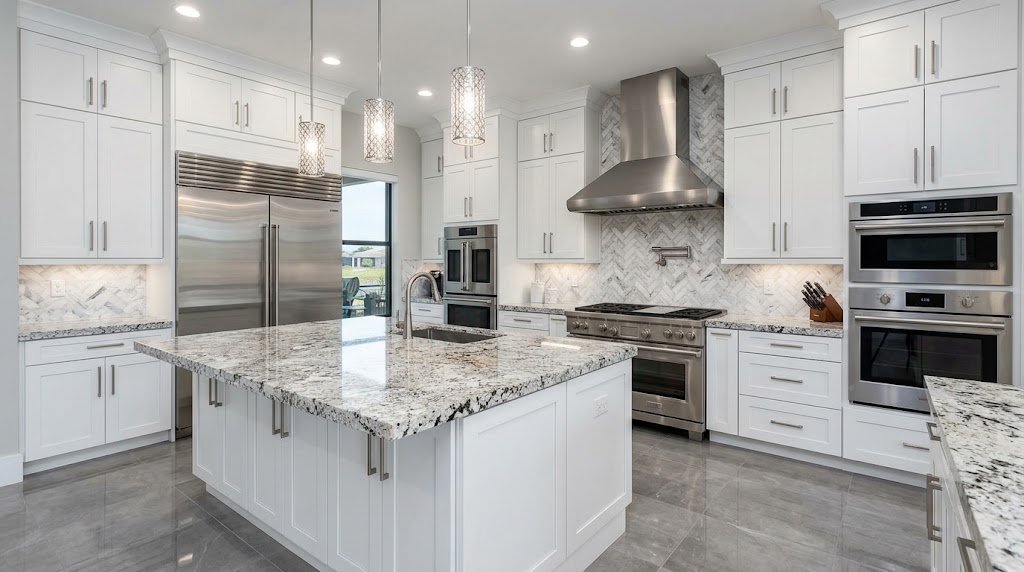
Which Black Granite Colors Should You Shortlist?
Black granite is rarely just black. Veining is what separates these options, from cool gray and white to warm cream and gold.
What Does Black Agata Granite Look Like?
Black Agata has “a dark black background with light gray and white wavy veins,” per its product page. Here the background, meaning the main color behind the veining, reads as true black. Gray and white veins add movement without introducing another hue, so it works with many cabinet tones. In a dim kitchen, though, a full run of black can feel heavy. Its page notes that each slab has unique veining, so check the waves on the exact piece you tag.
How Do Black Cosmic, Titanium and Stormy Night Differ?
All three start with a black base; the veining is the difference. On Black Cosmic, “the majority of the slab is black accented with beautiful swirls and veins of creams and gold,” which warms it up; it is also the backup if Black Agata is unavailable. Titanium gets its look from “the deep black background and the swirling white and gold veins,” mixing warm and cool. Stormy Night has “a black background and dramatic snowy white veins,” with tonal veins throughout, making it the most graphic of the three. Bold veining shows across seams, so plan the layout with your fabricator. A good approach is to start with one warm-veined black and one white-veined black, then compare them in person.
Why Is Dark Granite Back in View?
Houzz’s 2026 surfaces trends call this direction “Dark Drama”: black surfaces with veining in whites, creams, browns and golds. It is a national look at kitchen surfaces overall, not granite sales or San Diego. A veined black adds depth and contrast without reading as a flat block of color. In a small or dim kitchen, though, too much black can close the room in. If that worries you, pair a black island with a lighter perimeter so you get the drama without losing brightness.
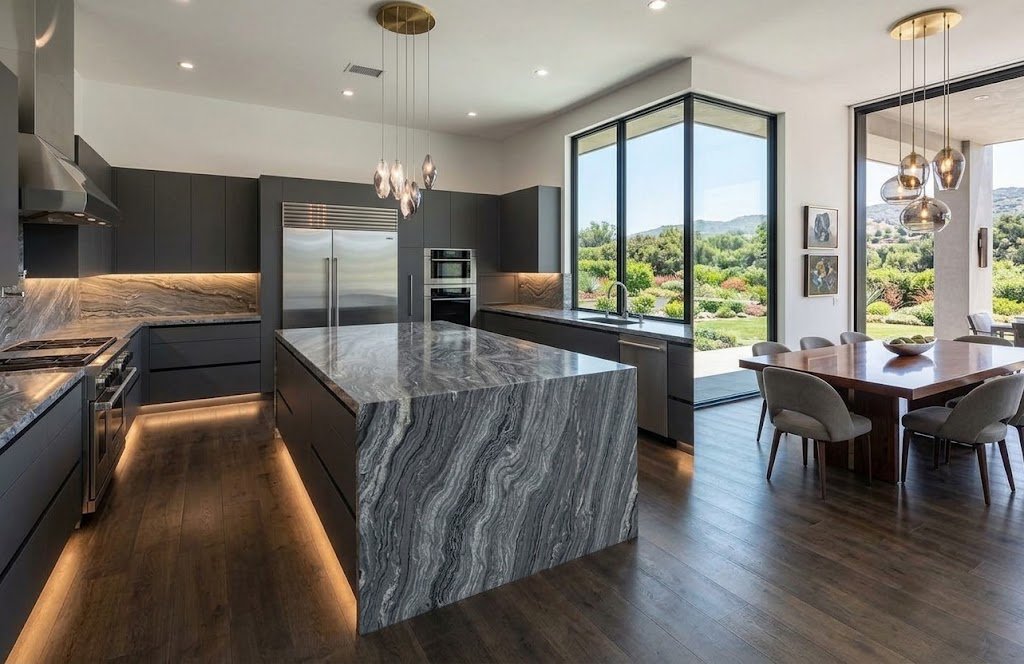
Which Gold and Brown Granite Colors Should You Shortlist?
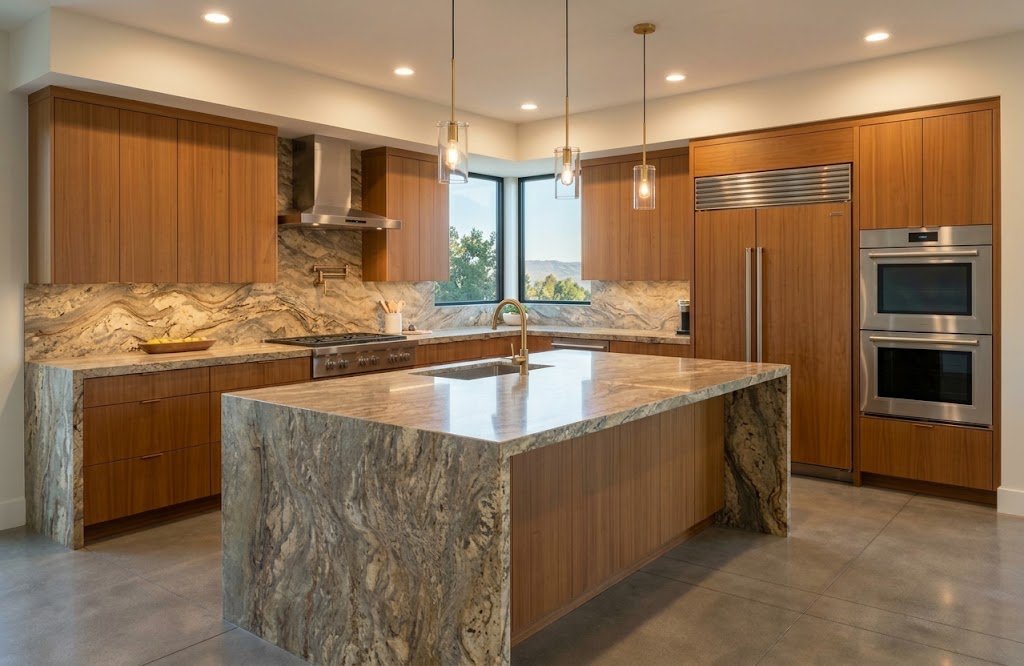
Golds and browns make up the warmest family, ranging from light gold and beige to deep caramel, and they sit naturally next to wood and cream cabinets.
What Does Giallo Ornamental Granite Look Like?
Giallo Ornamental is “a veined granite with a tan background with dark gray and brown veins,” and its page adds that it has a polished finish. Its tan and brown palette fits the warm-neutral direction in Houzz’s national 2026 surfaces trends for kitchen surfaces overall. That polish deepens the tan and sharpens the darker veins. If you’d prefer less shine, ask what finishes are in stock. It’s a natural fit for a warm kitchen with wood or cream cabinets.
What Does Brazilian Wood Granite Look Like?
The Brazilian Wood product page keeps it brief: the slabs “feature a variation of creams, yellows, golds, and browns.” Based on that wording, it belongs in the golds and browns family. The page doesn’t cover its veining or movement, so judge that in person. It does say each slab is sourced from natural stone quarries and is unique, so put it on your list if a creams-to-browns range fits your kitchen.
How Do Golden Crystal, Toffee and Juparana Persa Compare?
Golden Crystal features “a stunning mix of soft gold, beige, and light gray tones, beautifully accented with deep brown and amber mineral deposits,” and its page credits the flowing patterns with adding depth and warmth. Toffee is “rich and warm with shades of gold and browns,” making it the deepest of the group. Juparana Persa is “rich in gold tones and creams with deep charcoal veins,” and its page calls it a high variation granite, meaning the pattern shifts noticeably across the stone; those charcoal veins add contrast the softer golds lack. Golden Crystal and Toffee are the backups if Giallo Ornamental is unavailable, so pick the depth of warmth you want and compare two at the yard.
Why Do Golds and Browns Suit Wood Cabinets?
This family lines up with two national trends. The NKBA 2026 Kitchen Trends Report, a national survey of kitchen trade professionals about kitchens overall, found wood grain cabinets growing (59%) and white oak the most popular wood (51%), and Houzz’s 2026 surfaces trends, also national and about kitchen surfaces overall, note that warm neutrals pair with natural wood tones. Warm stone and warm wood share undertones, but too close a match can blur together: gold granite beside honey-toned wood may look like a single shade, so look for contrast in the veining. Bring a cabinet door to the yard to test the pairing.
Which Blue Granite Colors Should You Shortlist?
Blue is the contrast family and works best as a statement; below you’ll find a deeper option and a lighter one.
What Does Blue Pearl Granite Look Like?
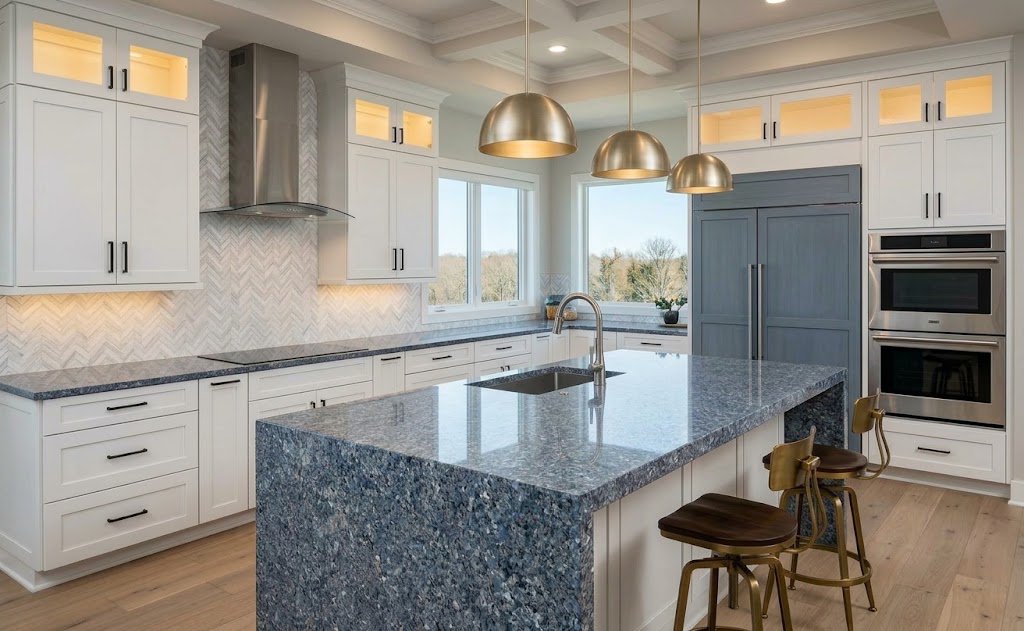
Blue Pearl showcases “a stunning blue, dark blue, or gray-blue background color, adorned with captivating silver or blue iridescent mineral flecks,” according to the product page. Flecks are small bits of contrasting mineral, and iridescent means they shimmer and shift color as light moves across them. Photos rarely capture that effect, so see it in person. Blue is a commitment, which is why it often goes on one area rather than every countertop.
What Does Opala Granite Look Like?
The Opala product page describes “dramatic hues of blues highlighted with white and gray.” Those white and gray highlights give it a lighter feel than Blue Pearl’s darker range. It’s also the backup if Blue Pearl is unavailable. If you lean toward blue-green, Amazonite is worth a look; its page describes “a captivating blend of blue-green hues.” Put Opala and Blue Pearl side by side to decide how bold you want to go.
Where Does Blue Granite Work in a Kitchen?
In the NKBA 2026 Kitchen Trends Report, a national survey of kitchen trade professionals about kitchens overall (not granite and not San Diego), 78% of respondents named blues among the most popular colors, and statement color is expected on the backsplash (60%), wallpaper (60%) and island (57%). An island keeps the color in one spot while the perimeter stays neutral. Keep in mind this is a national trend, not a report on what sells at either of our locations. If blue appeals to you, start with the island and pair it with a neutral perimeter slab from the whites or blacks above.
How Does the Finish Change a Granite Color?
Finish is the surface treatment of a slab, and by changing sheen it changes how color reads. Our granite countertops and slabs page describes each finish.
How Does a Polished Finish Change Granite Color?
Polished granite has a glossy, reflective surface that highlights the natural colors and patterns of the stone, and it is smooth to the touch. More reflection makes tones appear deeper and veins sharper, which is why a polished black looks blacker. It also shows glare from windows and fixtures. View polished slabs under light similar to what you have at home.
How Does a Honed Finish Change Granite Color?
Honed granite has a smooth, satin-like finish made by grinding the surface to a consistent, matte appearance. Its sheen is low and it reflects less than a polished surface, but it keeps the natural colors and patterns of the stone. Less reflection softens contrast, so a honed slab can look a shade lighter and more muted than the same stone polished. Not every stone is stocked in every finish, so ask whether your favorite comes honed.
How Does a Leathered Finish Change Granite Color?
Leathered granite, also called brushed granite, has a textured surface that resembles leather. Gently brushing the stone gives it a soft, matte look that is less reflective than a polished finish. The texture changes how light hits it, so color reads softer and the surface feels tactile. Some leathered slabs in stock are grays, which fall outside the four families above; Matrix Leather, for example, is described as “a subtle tonal gray granite with lighter gray veins.” If you want to downplay shine, ask which of your picks come leathered.
Put simply, polished reads deepest, while honed and leathered come across softer.
Why Should You See the Full Slab Before You Choose?
Photos work well for a preview. Seeing the full slab is what decides it.
Why Does the Full Slab Matter More Than a Photo?
Color and veining vary from one piece to the next, even within one named stone, so a photo can mislead. The kitchen images on this page show a general direction, not your exact slab. Screens shift hues, and a small sample can’t show how veins travel across a whole countertop. Tag the full slab you want and we’ll hold it for your project, so the stone you chose is the one that gets installed.
How Do You Plan Your Visit?
Walk-ins are welcome, but we recommend an appointment so a stone expert is ready to walk the yard with you. Our San Diego yard sits on Camino Ruiz just off Miramar Road, and our San Marcos yard is on N Pacific Street. Bring a cabinet door, a floor or tile sample and your list of favorite slabs, and preview inventory first in our slab yard gallery.
Come See Full Slabs at Our San Diego Yard in Miramar or Our San Marcos Yard
Ready to narrow down your favorites? Come see full slabs at our San Diego yard in Miramar or our San Marcos yard, where our expansive selection of granite is on display. Call San Diego at (858) 530-3030 or San Marcos at (760) 744-7415, schedule an appointment, or request a free estimate. We sell the slabs; your fabricator handles fabrication and installation, and we can point you to local fabricators.
San Diego (Miramar): 9483 Camino Ruiz, San Diego, CA 92126, (858) 530-3030
San Marcos: 135 N Pacific Street, Suites A & D, San Marcos, CA 92069, (760) 744-7415
Hours at both locations: Monday to Friday 8:00 AM to 5:00 PM, Saturday 9:00 AM to 5:00 PM. Visit our San Diego or San Marcos location.
Frequently Asked Questions
Does Brazilian Exotic Granite install the granite I pick?
No, Brazilian Exotic Granite sells the slabs; your fabricator or contractor handles fabrication and installation. If you don’t have a fabricator yet, we can point you to local fabricators. You choose and tag your slab at the yard, and your fabricator takes care of the cutting, edges and installation. From there, ask them for an itemized quote.
Does Brazilian Exotic Granite serve Poway?
Yes. Poway is a service area, not a location, and our San Diego yard in Miramar is the closest place to see full slabs. According to our Poway page, the San Diego yard is roughly 20 minutes from Poway, depending on traffic. Poway homeowners can walk the yard, tag a slab and bring in their own fabricator. You’ll find more detail on our countertops in Poway page.
Can I preview granite colors online before I visit?
Yes, each stone on this page links to its own product page, and our slab yard gallery and project gallery show real stone. Product pages describe each slab’s background and veining in a sentence or two. Use them to narrow down your picks before you drive over. You’ll still choose the exact slab in person.
Do the San Diego yard and the San Marcos yard carry the same granite colors?
Both locations offer the same direct-import selection and pricing. Which slabs are on hand at each one on a given day is a different question, because availability at each yard changes over time. Call either yard to check before you visit: San Diego at (858) 530-3030 or San Marcos at (760) 744-7415. If one slab matters most, ask for it by name when you call.
Where does Brazilian Exotic Granite’s granite come from?
Every slab featured on this page lists Brazil as its origin country on its product page. As a direct importer, our buyers select blocks at quarries in Brazil and beyond. Origin is listed on each product page, so you can check any slab before you visit. Then come see the stone itself at the yard.
Can I get a free estimate for a granite color I like?
Yes, our free estimate form asks for your product interest, the product color and the square footage you need. Have rough countertop measurements handy before you fill it out. Use the message field to name the slabs you like. Or bring your measurements to the yard and ask in person.


